001 927 Jannik Hammes Fotografie
© Jannik Hammes Fotografie

Setting a new benchmark for a clean stack

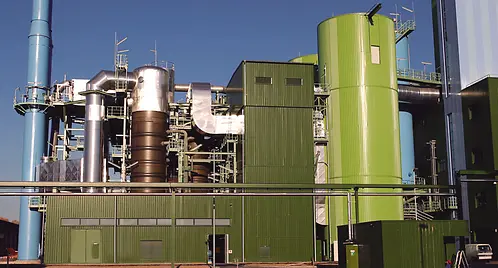
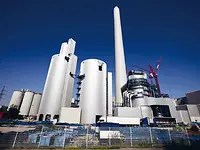
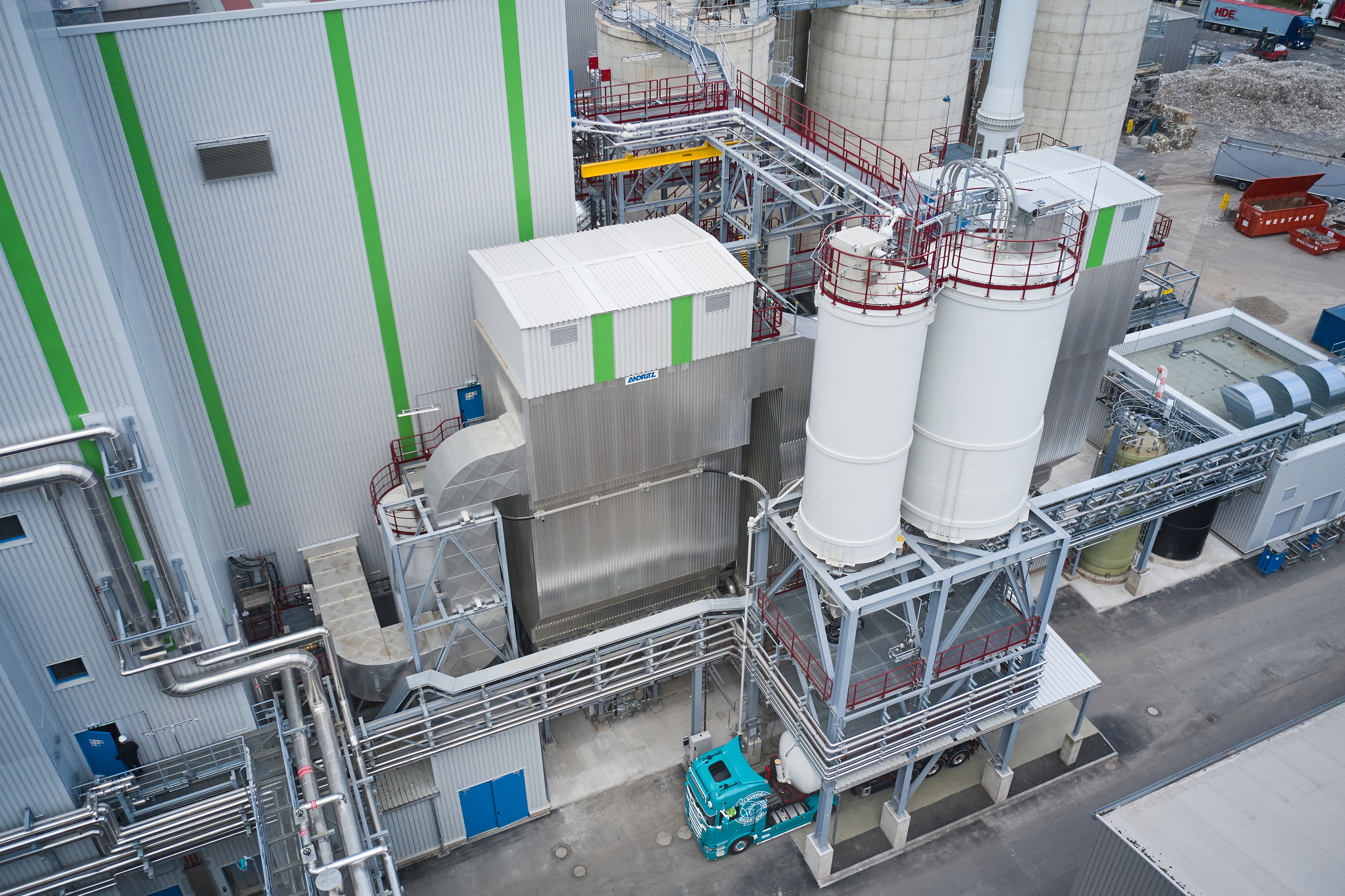
The Aschaffenburg waste-to-energy (WtE) plant in the heart of Germany’s industrial landscape has set a new benchmark in lowering emissions from the combustion of waste streams. Key to the remarkable results achieved by the plant is ANDRITZ’s comprehensive solution that integrates both combustion and flue gas cleaning elements.

014 927 Jannik Hammes Fotografie
© Jannik Hammes Fotografie

E.ON, the energy company, and DS Smith, the paper and packaging company (now part of International Paper), cooperated to build a new integrated WtE plant at DS Smith’s Aschaffenburg paper mill. The plant processes a diverse mix of waste streams to produce steam and heat for the adjacent paper mill while significantly reducing reliance on fossil fuels. Handed over in December 2025, the plant, including an ANDRITZ EcoFluid BFB boiler complete with an advanced flue gas cleaning system, continues to exceed expectations.

“We were convinced that ANDRITZ was the right partner for this project as we very much liked its concept for the boiler and were particularly impressed with the flue gas cleaning system,” says Günter Schneider, Project Manager at E.ON. 

A PROJECT SHAPED BY COMPLEXITY

One of the key challenges of the Aschaffenburg project is the extreme variability of the fuel mix, ranging from Refuse Derived Fuels (RDF) and rejects to paper sludge, sewage sludge, and biomass residues. This results in strongly fluctuating flue gas compositions, with continuously changing levels of acid gases, dust, heavy metals, and other pollutants.

At the same time, the customer’s ambition was not just to comply with the regulatory requirements, but to achieve emission levels below the EU IED BAT-AELs and the German 17th BImSchV (Verordnung über die Verbrennung und die Mitverbrennung von Abfällen) limits. This combination of highly dynamic process conditions and very strict emissions targets defined the project from the outset. 

INTEGRATED DESIGN: FROM COMBUSTION TO CLEANING 

At the core of the plant, ANDRITZ’s EcoFluid BFB boiler efficiently converts heterogeneous residual fuels – including paper mill rejects, bark, wastewater sludge, and sorted waste – into energy. Combined with the downstream flue gas cleaning system, the integrated ANDRITZ design provides the customer with an efficient, robust, and reliable solution. On one hand, the boiler ensures high thermal conversion of the fuel and reliable energy recovery, and, on the other hand, the various flue gas cleaning equipment optimize reagent needs while strongly minimizing emissions to air. From the beginning, both systems were developed as an integrated solution. 

039 927 Jannik Hammes Fotografie
© Jannik Hammes Fotografie

MULTI-STAGE FLUE GAS CLEANING

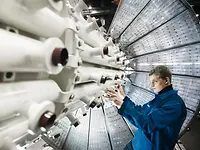
The flue gas cleaning system is based on a very compact multi-stage dry concept, combining a series of proven and robust proprietary technologies in a layout that reduces the overall footprint requirement.

Upon exiting the boiler, the flue gases are combined with dry sorbents, in this case sodium bicarbonate and activated carbon, which are injected upstream in the first Fabric Filter (FF). In this 1st stage, the acid gases, such as SOx and HCl, the Heavy Metals (HM), the dioxins, some other trace pollutants and of course the dust are abated. After this first stage, a solution of aqueous ammoniac is injected, using ANDRITZ proprietary injection grid, upstream of the selective catalytic reduction (SCR) unit.

In this 2nd stage, where the flue gas temperature remains within a favourable range, the NOx emissions are converted into harmless N₂ and water. Finally, in the 2nd FF, 3rd stage of ANDRITZ solution, additional fractions of mercury, HM and HCl, are further removed to meet the ultralow emissions limits.

A DIFFERENT APPROACH TO DRY SORPTION

The flue gas cleaning system is particularly innovative, as Johannes Meyer, Technical Project Manager at ANDRITZ, says: “Compared to 2-stage solutions, we chose a different path by pioneering a multi-stage system starting with a sodium bicarbonate / FF stage which enables to remove various pollutants while maintaining the flue gases at elevated temperature. This solution allows for efficient NOx abatement in the SCR reactor and avoids the addition of a costly reheat system. 

In short, from an energy perspective the system is well-integrated and translates into maximum plant thermal efficiency reducing the overall specific emissions, including CO₂.”

Since start-up, performance results from the flue gas cleaning system have been impressive with results well below customer expectations. Johannes Meyer continues: “The ANDRITZ flue gas cleaning system features our optimized consumables concept that ensures the plant operates consistently high on the merit curve. This is important, because over the long lifetime of this type of plant, the total cost of consumables can approach or even exceed the initial installation cost.” 

CUSTOMER-CENTRIC COLLABORATION OVERCOMES INSTALLATION CHALLENGES 

The project initially faced demanding conditions, including an extremely limited site footprint that required an innovative layout maximizing every square meter. Up to 26 contractors worked simultaneously, creating complex interface management. ANDRITZ successfully coordinated its scope in this crowded environment. Despite these constraints, commissioning proceeded smoothly. 

Thomas Strasser, Director of Sales, Power Boilers, ANDRITZ, emphasizes the achievement: “We started one piece of equipment after another with no problems with a notably fast ramp-up curve. In my career as a commissioning engineer, I have never experienced anything like it. It was outstanding.” 

Open dialogue with E. ON enabled proactive problem-solving during the project, with ANDRITZ continuing to maintain close contact via its local German subsidiary, just three hours from the site. 

“This project clearly underlines E.ON’s successful partnership with ANDRITZ,” Strasser concludes, “The plant stands as a compelling reference for waste-to-energy projects facing space constraints, fuel variability, and tight emissions”. 

A TRUE “ONE ANDRITZ” PROJECT

In an exceptionally broad scope of supply, ANDRITZ provided solutions throughout the project, from engineering and erection to commissioning and including, notably, both the flue gas cleaning and boiler technologies.

The pressure parts were manufactured at ANDRITZ TermoEnergetskaPostrojenja (TEP), a boiler expert company that joined the Group in 2023.

ANDRITZ Project Manager Wolfgang Pichler highlights the benefits: “We always worked as one team on this project. Close cooperation across business areas made it possible to solve problems efficiently and deliver a strong overall solution.” 

A STRONG REFERENCE FOR THE INDUSTRY

By combining a flexible boiler with a robust and adaptable flue gas cleaning system, the plant turns challenging operating conditions into reliable performance. The optimized temperature ranges throughout the boiler and flue gas cleaning systems ensure high thermal efficiency, maximizing fuel utilization and steam production.

For E.ON, the outcome confirms the importance of choosing the right overall concept from the start – or as Günter Schneider, Project Manager, put it, “The outcome is a very positive surprise.”

INNOVATION AT THE CORE OF ANDRITZ

Through continuous R&D, ANDRITZ is further developing key process technologies to improve emission reduction, energy efficiency, and operational reliability under demanding plant conditions. ANDRITZ also has a strong focus on advancing circular economy solutions with the aim to increase resource efficiency, maximize material recovery and recycling, reduce waste generation, and support closed-loop production processes across the energy sector. 

001 927 Jannik Hammes Fotografie

GETTING TECHNICAL

The scope of supply delivered by ANDRITZ to the Aschaffenburg waste- to-energy project includes:

EcoFluid Bubbling Fluidized Bed (BFB) Boiler and advanced flue gas cleaning system with the following parameter:

  • Fuel: Refuse-derived fuel (RDF), rejects, paper sludge, sewage sludge, bark
  • Steam conditions: 36 t/h, 420 °C, 40 bar(a)
  • Flue gas cleaning: Dry Sorbent Injection (BiCar) with 1st Fabric Filter, Selective Catalytic Reduction unit, 2nd Fabric Filter and various auxiliaries (residue transport and reagenhts / by-products storage systems). 
The WtE plant has reduced the dependency on natural gas for the energy supply of the paper mill by 25% – enough to heat a town of 85,000 inhabitants – while also saving 50,000 tons of CO₂ a year.

Overall, the project demonstrates how a smartly engineered multi-stage boiler and flue gas cleaning system can successfully handle highly variable fuels while delivering ultra-low emissions and high energy efficiency – fully aligned with the demanding requirements of modern waste-to-energy plants.