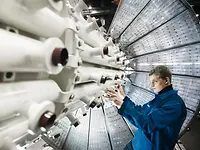
ANDRITZ offers centrifugal pumps and submersible motor pumps for various water and waste water applications and processes.
Not a drop to drink
Why the world needs a new way to think about water
"Water, water, everywhere / Nor any drop to drink," wrote Samuel Taylor Coleridge more than two centuries ago. It remains the paradox of our age. Water covers roughly 71% of the Earth's surface, yet less than 1% of it is fresh and readily accessible, and for a quarter of humanity, a safe glass of water is still not a given. Getting water to people – safely, and when they need it – has always been a hard task. And it is getting harder.
Today, 2.1 billion people still lack access to safely managed drinking water. The shortfall is not really about the volume of water on Earth; it is about getting it to the right place, at the right time, in a condition safe to drink. And that has always depended on engineering.
For decades, that engineering rested on a single, reasonable assumption: that water crises are high impact, but low likelihood. It was the right approach for its time: fixed infrastructure – reservoirs, dams, pipelines, treatment plants – built to last and built to a scale big enough to shrug off the occasional emergency.
That infrastructure is still necessary. But it is no longer sufficient.
In the decades since developing economies built their water infrastructure, the world has changed. The climate crisis is, above all, a water crisis, according to United Nations Water. Glaciers, ice fields, and other sources of water are shrinking. Floods can contaminate clean water with salt or waste. Extreme heat causes forest fires, and the loss of tree cover slows down the replenishment of groundwater. Drought and shifting rainfall do not only reduce how much water is available; they change its character – concentrating pollutants and raising the organic load that must be stripped out before a single drop is safe to drink.
Water infrastructure was built to handle rare one-off crises, not this cascade of compounding, overlapping threats.
The pressure is human, too. Urbanization is one of the great megatrends of our time – unstoppable, and fastest in the developing world. Every year more people crowd into cities, overloading networks never built for them and leaving no room to expand the plants that treat their water. Add aging infrastructure with little redundancy, seasonal tourism that swells local demand overnight, and even cyberattacks on the systems themselves.
And the bar for "safe" keeps rising. Trace pharmaceuticals, microplastics, and persistent "forever chemicals" like PFAS slip through processes designed for a simpler roster of contaminants, and regulators keep lowering the limits for what may remain. Each turn of that ratchet is a public-health gain – and a new demand on the systems that treat the water.
Water crises remain high impact. But low likelihood? Not anymore.
And there is a financial dimension, too. Replacing and upgrading legacy systems is costly – often more than municipal budgets can comfortably absorb. As doing more of the same becomes harder to sustain, the question shifts from how to build to how to build smarter.
To maintain water security, and to bring it to regions where it is not yet established, the world needs a dominant new approach that reckons with this new normal.

Drinking water security
FROM PERMANENCE TO PREPAREDNESS
This is the shift the sector has to make – and it is a shift in mindset before it is a shift in hardware. If the whole region's drinking water depends on a single dam, what is the plan for when the dam breaks? When the signs of a crisis start to show, it is already too late to build a large-scale solution. Security in this new reality rests on two ideas the old model underused: speed and redundancy.
Speed means the ability to treat water where and when it is needed: standardized, containerized filtration plants that can be deployed in hours to restore safe supply after a flood, an outage, or in places permanent infrastructure has never reached.
Redundancy means widening the bottlenecks: multiple sustainable sources, distributed networks of efficient pumping stations that move water where it is needed with minimal loss and energy, and the ability to reroute around damage rather than watch a single point of failure take a whole region offline.
Preparedness is not only physical. It also depends on understanding how water networks behave in real time. Smart leak detection is a clear example: by continuously modelling the network, it spots and locates leaks early – even where sensors are sparse – cutting water losses and keeping supply reliable.
Around this sit the quieter fundamentals of the trade: pumps that keep water moving through the system, intake screening that protects both the network and its river, filtration that turns raw water potable, and separation Technologies that let communities and Industry reuse water they once discarded. As pressure on freshwater resources grows, water reuse is increasingly becoming a strategic source in its own right, helping cities and industries close the loop and reduce dependence on scarce supplies.
None of this replaces robust core infrastructure. It completes it, turning a rigid system into a prepared one.
A COLLAGE OF SOLUTIONS
This is, in the end, the practical work behind Sustainable Development Goal 6: safe water for everyone by 2030. It won't be achieved by building more of the same, but by rethinking how water systems are designed to cope with constant change.
A cascade of overlapping crises calls for a collage of overlapping solutions. Safe drinking water is a basic necessity of human life, and securing supplies may be the defining challenge of our time. It will require rethinking much of what the world has learned about water security – and ANDRITZ is among the organizations already proving willing to change, and to help lead that shift.
Discover more
Pumps for the water industry
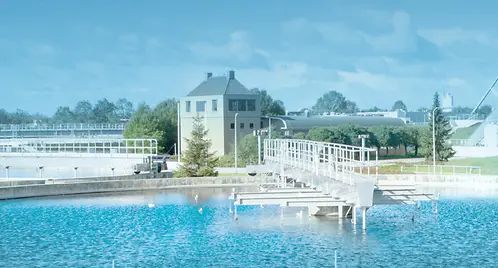
Water, water re-use, desalination
Secure safe and sustainable water supply with energy-efficient desalination, smart filtration, and screening, and pumping. Trusted in cities worldwide.
The Shift magazine

The Shift - Issue 01
The 1st Shift – Technology. Transition. Trust. We are delighted to introduce you to The Shift, the new magazine from our Environment & Energy business area.

Pumps for the water industry
ANDRITZ offers centrifugal pumps and submersible motor pumps for various water and waste water applications and processes.
Desalination, water, water re-use
Secure safe and sustainable water supply with energy-efficient desalination, smart filtration, and screening, and pumping. Trusted in cities worldwide.

The Shift magazine

THE SHIFT - Issue 01
The 1st Shift – Technology. Transition. Trust. We are delighted to introduce you to The Shift, the new magazine from our Environment & Energy business area.