


ANDRITZ OY
Tammasaarenkatu 1
00810 Helsinki
Finland

Juho Saastamoinen, Product Manager for chloride and potassium removal plant service at ANDRITZ, sees proper maintenance of the chloride and potassium removal plant as an investment to secure the most important processes in a pulp mill.
"In short, the system treats ash from electrostatic precipitator (ESP), returns valuable elements back to the cycle, and removes harmful non-process elements, such as chloride and potassium. If this does not function as intended, the recovery boiler cannot operate at its full capacity,”

Decanter centrifuge in ANDRITZ Ash Leaching (ALE) ©ANDRITZ
Regarding the chloride and potassium removal process, chemical recovery and removal are among the most sensitive processes in the entire pulp mill. Both valuable and unwanted chemicals react quickly to changes in process conditions, which makes stable and well-controlled operation critical.
Pusher centrifuge in ANDRITZ Ash ReCrystallization (ARC) ©ANDRITZ
“Operation needs to stay within the right limit values. For example, if temperature, density, or pH values are not optimal, deposits begin to form and the plant’s ability to treat ash weakens.”
The most sensitive part of the process is the centrifuge, where the actual separation of valuable and harmful chemicals takes place. This is especially true for evaporative crystallization systems where the typical centrifuge cannot handle excessively small crystals, whereas the centrifuges used in leaching applications are more sensitive to pH changes.
Crystals from ANDRITZ Ash ReCrystallization (ARC) ©ANDRITZ
"In evaporative crystallization, optimal crystal formation is essential. If the crystals are too small, the separation no longer works effectively, and the centrifuge cannot perform its task. As a result, the negative impact on the recovery boiler develops gradually, with chloride and potassium accumulating in the process and progressively affecting boiler performance,” Saastamoinen explains.
Most optimization actions, such as process inspections, can and should be carried out during operation. More extensive inspections should be carried out during planned shutdowns to support effective maintenance planning.
One of the most important changes that Juho Saastamoinen and the Global Product Group Manager, Evaporation Service at ANDRITZ, Casimir Svensson, would like to see is a stronger overall understanding of the critical role of the process.
“The chloride and potassium removal plant is not a secondary asset that can be left outside daily maintenance and planned shutdowns. Operators always need to know whether it is removing what it should remove as well as whether the system is returning maximum value back to the cycle.”

To help customers achieve this capability, ANDRITZ offers chloride and potassium removal plant services that combine mechanical maintenance and systematic process-level optimization during operations as well as planned shutdowns.
“As a partner, ANDRITZ provides support across the entire system from components, centrifuges, and instrumentation to systematic, process-level maintenance. This support is available for all types of chloride and potassium removal plants regardless of the original equipment manufacturer. “The goal of our services is not just to maintain a unit. We help to keep recovery boiler risk under control,” says Svensson.
Are chloride and potassium levels within the target range? Is removal efficiency stable over time or drifting?
Are key parameters, such as flows, concentration, and separation conditions within optimal range? Are deviations identified early or only after they affect the boiler?
Are valuable chemicals effectively recovered? Or are they being lost from the process?
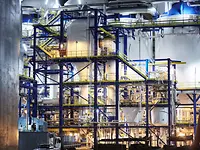
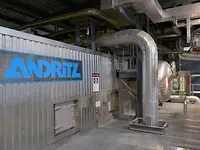
ANDRITZ offers a full line of systems for chloride and potassium removal from precipitator ash.
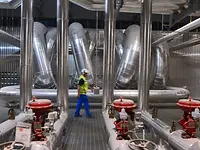
ANDRITZ recovery plant service experts work in close cooperation with you to improve the performance, stability, availability, and efficiency of your recovery boilers and auxiliary equipments.

With over 120 years of experience and a strong global presence, US headquartered Diamond Power brings deep expertise in advanced boiler cleaning technologies and services. These solutions are widely used across the pulp & paper, utility, biomass, waste-to-energy, and industrial sectors.